


In-Building Wireless Systems
BDA and DAS Installation
in South Florida
Reliable in-building radio and cellular coverage is essential for large commercial properties, high-rises, hotels, healthcare facilities, warehouses, stadiums, campuses, and mixed-use developments. SEI Wireless Solutions designs, installs, tests, and supports Bi-Directional Amplifier (BDA) and Distributed Antenna System (DAS) infrastructure throughout South Florida.
Our team helps property owners, operations leaders, facility teams, contractors, and security directors improve in-building communication coverage with professionally planned systems, RF site surveys, grid testing, AHJ coordination support, installation, commissioning, and ongoing service.
BDA vs. DAS
What Is the Difference Between BDAs and DAS Systems?
BDA and DAS systems are often discussed together because both help improve signal coverage inside buildings. The right solution depends on the type of signal being supported, the structure of the building, local requirements, and the results of RF testing.
Bi-Directional Amplifier
Bi-Directional Amplifier (BDA): A BDA system strengthens an available radio signal. It receives signal from outside the building, amplifies it, and helps support reliable radio communication inside areas where coverage may be weak or inconsistent.
Distributed Antenna System
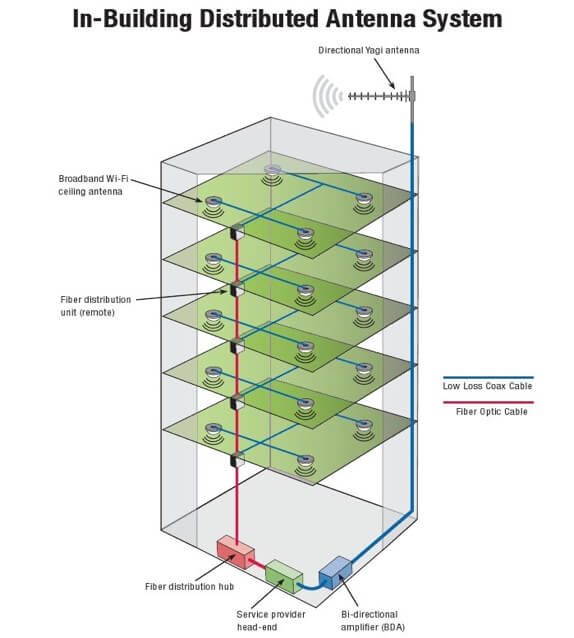
Distributed Antenna System (DAS): A DAS distributes signal throughout a building using strategically placed antennas, cabling, and related components. DAS infrastructure may support radio, cellular, or multi-carrier coverage depending on the project requirements.
For many commercial buildings, the system design may include both BDA and DAS components to support reliable in-building radio coverage from the outside signal source to the areas that need coverage inside the property.
- Bi-Directional Amplifier (BDA): Strengthens the radio signal to improve in-building coverage. Important considerations include frequency bands, gain, signal source, interference, system monitoring, backup power, and AHJ requirements.
- Distributed Antenna System (DAS): Distributes signal across the building through a planned network of antennas, cabling, splitters, and related components.
- Donor Antenna: Receives the outside signal and helps feed the system.
- Indoor Antennas and Cabling: Deliver coverage to designated areas such as floors, corridors, stairwells, parking areas, utility spaces, and other coverage zones.
- Power and Monitoring Components: Support system reliability and may be required as part of code-aligned system design and documentation.
- Testing and Documentation: RF measurements, grid testing, reporting, and verification help confirm system performance and support the approval process.
| Component | Primary role | Important design considerations |
|---|---|---|
| Bi-Directional Amplifier (BDA) | Strengthens an available radio signal | Frequency bands, signal source, gain, interference, backup power |
| Distributed Antenna System (DAS) | Distributes the signal throughout the property | Antenna placement, cable pathways, floor coverage, signal balance |
| Donor antenna | Receives the available outside signal | Location, signal quality, obstructions, isolation from indoor antennas |
| Indoor antennas and cabling | Delivers the signal to designated coverage areas | Building materials, ceiling access, pathways, coverage objectives |
BDA System Installation, Testing, and Compliance in South Florida
A BDA system is not a one-size-fits-all installation. Building size, construction materials, floor plans, frequency requirements, signal strength, AHJ expectations, and future use all influence the system design.
SEI supports BDA system projects from early evaluation through installation and verification. Our process helps commercial property teams understand where coverage gaps exist, what type of system may be needed, and how to move the project forward with the right technical support, documentation, and service plan.
Public-Safety BDA and ERRCS
Emergency Responder
Radio Coverage, BDA, and ERRCS
Many commercial buildings are required to maintain reliable in-building radio coverage for emergency responder communication. A BDA system may be used as part of an ERRCS — Emergency Responder Radio Communication System — when the building does not meet required signal-strength levels.
In Florida, applicable new and existing buildings may need to meet minimum in-building radio coverage requirements. The local Authority Having Jurisdiction (AHJ) determines what is required, reviews testing documentation, and may require signal enhancement based on the results of RF grid testing.
SEI helps project teams navigate this process with site surveys, system planning, installation support, verification testing, and documentation for AHJ review.

Florida law requires applicable new and existing buildings to meet minimum radio signal-strength requirements for public-safety agency communications. However, a BDA is not automatically required in every building. The local Authority Having Jurisdiction, or AHJ, determines the applicable signal requirements and may require an enhancement system when testing shows that interior coverage is inadequate. Building type, size, construction, use, and statutory exemptions can all affect the requirements.
We help project teams evaluate existing coverage, understand the technical scope, and prepare for local review.
Early planning is especially important when public-safety radio coverage could affect a construction schedule or Certificate of Occupancy. No contractor can guarantee approval by an independent AHJ, but experienced assessment, design, coordination, and documentation can help identify coverage problems before the final inspection stage.
- RF site surveys and signal-strength testing
- RF grid testing across required building areas
- iBwave system design and engineering coordination
- BDA, DAS, donor antenna, cabling, and equipment specification
- Equipment procurement and installation
- System commissioning and performance verification
- Coordination with the AHJ, inspectors, and frequency licenseholder
- Testing reports, closeout documents, and certification support
- Ongoing maintenance and service
When Does a Commercial Building Need a BDA System?
A commercial building may need a BDA system when radio coverage inside the property is weak, inconsistent, or does not meet local requirements. This often happens in buildings with concrete, steel, low-E glass, underground areas, stairwells, elevators, parking structures, or large interior spaces where outside signals cannot reliably penetrate.
RF Site Survey & Grid Testing
What Happens During an RF Site Survey?
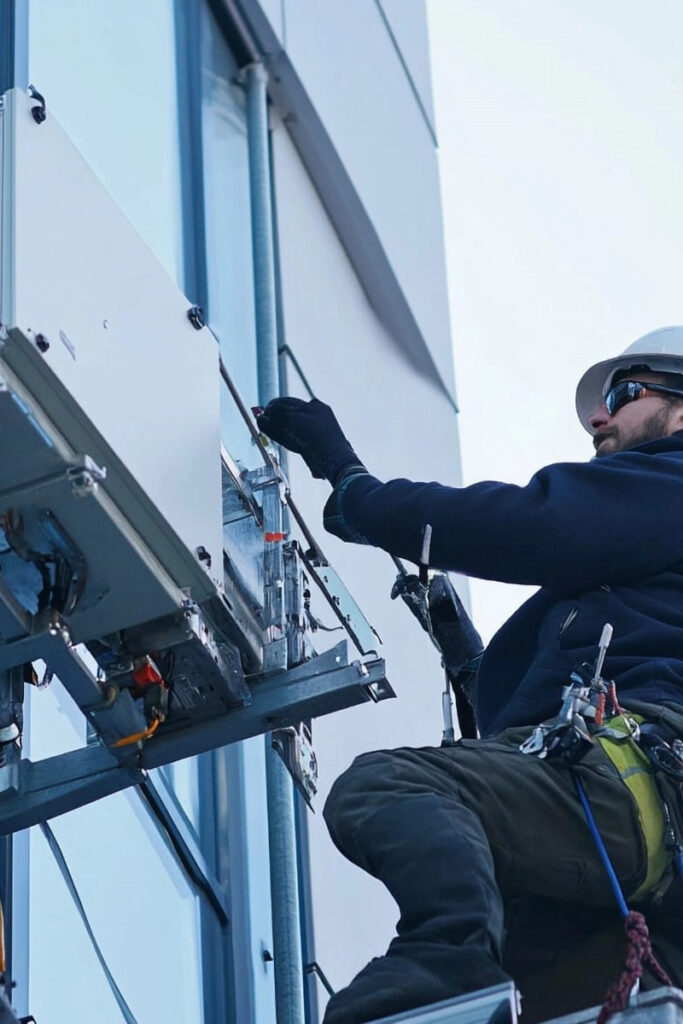
An RF site survey measures radio signal strength throughout a building to identify weak coverage areas and determine whether a BDA or DAS system may be needed. This testing gives property owners, contractors, and operations teams a clearer understanding of the building’s current coverage conditions.
- RF Grid Testing: The building is divided into designated test areas, and signal measurements are recorded throughout the space. These results are used for system design, verification, reporting, and AHJ review.
- Coverage Gap Identification: Testing helps identify areas such as stairwells, elevators, corridors, parking levels, equipment rooms, and interior spaces where signal strength may be reduced.
- Documentation and Reporting: Clear reporting supports decision-making, design planning, and approval workflows.
The testing plan varies by property. A hospital, high-rise residence, warehouse, school, stadium, and mixed-use development can have very different construction conditions and coverage objectives.
RF Grid Testing and Performance Verification
During RF grid testing, designated areas of the building are divided into a test grid and signal measurements are recorded within each section. Testing must follow the criteria applicable to the project, which may include multiple floors, critical areas, and required frequency bands.
Results are documented for design, verification, and AHJ review. If testing identifies a coverage deficiency, the cause and required design response can be evaluated before the system proceeds to final acceptance.
Cellular DAS and Neutral-Host Systems
Solutions Beyond Public-Safety Radio
DAS infrastructure can also support cellular coverage needs in properties where guests, staff, tenants, or operations teams experience dropped calls, slow data, or inconsistent service.
A cellular DAS may be considered for large buildings, hotels, venues, campuses, and enterprise properties where reliable mobile connectivity is part of the overall guest, staff, or operational experience.
- Cellular DAS: Helps distribute cellular signal throughout a building using planned antenna and cabling infrastructure.
- Multi-Carrier DAS: May support more than one carrier depending on the system design and carrier participation.
- Neutral Host: A third party may develop and operate shared infrastructure that supports multiple carriers.
- Funding Structures: Cellular DAS projects may be property-owner funded, carrier/lead-carrier funded, or neutral-host supported depending on the opportunity and project requirements.
Common funding and ownership structures include:
Events & Hospitality
The property owner funds the system to improve service for occupants, tenants, guests, or operations.
Carrier or Lead-Carrier Funded
One or more carriers fund or participate in the deployment, depending on the property and expected demand.
Neutral Host
A third party develops and operates shared infrastructure that can support multiple carriers.
The appropriate model depends on the size and type of property, carrier interest, projected usage, ownership objectives, and available budget.
Our BDA / DAS Project Process
SEI supports BDA and DAS projects with a practical, step-by-step process designed to help commercial property teams move from initial evaluation to a working, documented system.
- Initial Consultation and Building Review
We review the property type, location, coverage concerns, project timeline, and known AHJ requirements. - RF Site Survey and Grid Testing
Signal levels are measured throughout the building to identify coverage gaps and determine next steps. - System Design and Engineering Coordination
The system is planned around the building layout, signal source, frequency requirements, antenna locations, cabling pathways, power needs, and compliance considerations. - Installation and Integration
BDA, DAS, antenna, cabling, and supporting components are installed and configured for the building environment. - Commissioning and Optimization
The system is tested and adjusted to support proper coverage and performance. - Verification, Reporting, and AHJ Support
Documentation and test results are prepared to support inspection, revi - Ongoing Service and Maintenance
SEI provides continued support to help keep the system performing as requirements, buildings, or technologies evolve.

Full Lifecycle Support
BDA and DAS Services From
Planning Through Support
SEI provides full lifecycle support for BDA and DAS projects, including:
This coordinated approach reduces the need for the customer to manage separate engineering, equipment, installation, testing, and service vendors.
New Construction BDA and DAS Planning
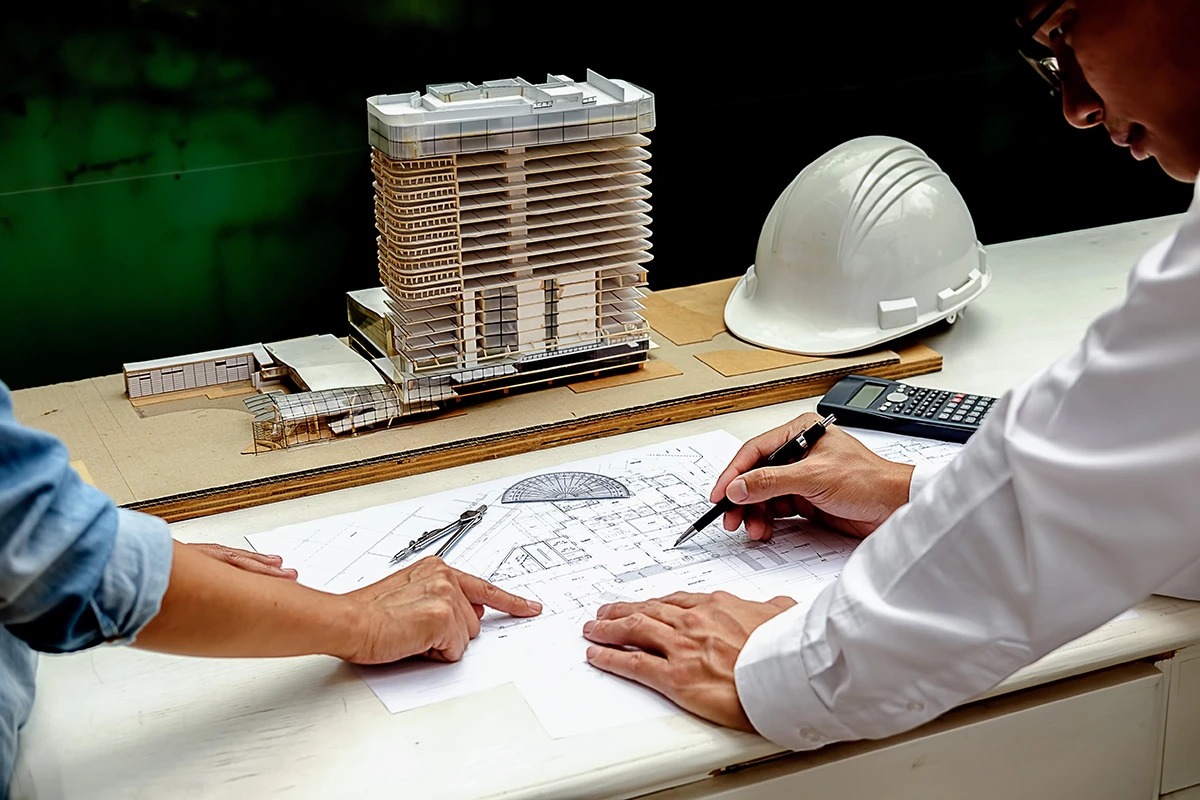
Involving the in-building wireless team during preconstruction allows pathways, equipment rooms, electrical requirements, donor-antenna locations, indoor antennas, and cable routes to be considered before walls and ceilings are complete.
We can review available floor plans and use iBwave software to develop a preliminary system approach and budgetary estimate. This gives developers, general contractors, electrical contractors, and property teams better information for planning and procurement.
A plan-based estimate is not the same as a final engineered scope. Final design decisions must reflect verified site conditions, tested signal levels, construction changes, frequency requirements, applicable codes, and AHJ criteria.
BDA and DAS Retrofits for Existing Buildings
An existing-building project begins with the conditions already present in the property. Occupied spaces, finished ceilings, limited riser access, legacy cabling, operating schedules, and existing equipment can all affect the installation plan.
The first step is to determine where coverage fails and what infrastructure can be retained. A retrofit does not necessarily require replacing every existing component. The final scope depends on system condition, supported frequencies, coverage requirements, access limitations, and the results of the RF assessment.
Retrofit planning is available for commercial buildings, residential high-rises, hotels, healthcare facilities, schools, warehouses, stadiums, and other properties where construction materials or building scale interfere with reliable in-building communication.

Compliance and AHJ Coordination
Working Within Applicable Codes and Standards
BDA, DAS, and ERRCS projects often involve specific technical, documentation, and approval requirements. These requirements can vary by jurisdiction, building type, system type, and the local AHJ.
- Florida Fire Prevention Code
- Florida Statute §633.202
- NFPA standards, including NFPA 72 and NFPA 1225 where applicable
- IFC Section 510 where adopted or referenced by the local jurisdiction
- FCC requirements and signal booster rules
- Local AHJ procedures and documentation requirements
- Frequency licenseholder coordination where required
- Requirements connected to Certificate of Occupancy or final project approval
- Backup power, monitoring, testing, and maintenance considerations
SEI helps property teams, contractors, and operations leaders coordinate the technical steps needed to support a smooth process from initial testing through final documentation.
Partners & Engineering
One Coordinated Team, From
Assessment to Ongoing Support
SEI brings together trusted technology, local service, and qualified engineering support for BDA and DAS projects.
- Motorola Solutions: SEI is a Motorola Solutions Platinum Channel Partner, supporting professional-grade communication systems for demanding commercial and enterprise environments.
- SINEWAVE Engineering Partnership: SEI partners with SINEWAVE to support the engineering, testing, and technical documentation behind BDA, DAS, and ERRCS projects. SINEWAVE’s BDA/DAS capabilities include in-building radio coverage design, antenna system planning, signal-strength testing, code-aligned documentation, maintenance, inspections, and troubleshooting.
For SEI clients, the SINEWAVE partnership strengthens project execution by combining SEI’s Motorola Solutions expertise, local service reputation, and enterprise communication experience with SINEWAVE’s RF engineering and antenna system support.
Learn more about SINEWAVE’s BDA / DAS antenna system expertise.
Track Record
Selected BDA and DAS Projects
Our experience includes public-safety BDA and cellular DAS projects across commercial, residential, hospitality, education, and government environments.
SEI has supported BDA and DAS projects across commercial, hospitality, enterprise, municipal, and education environments throughout South Florida.
Our experience includes public-safety BDA and cellular DAS projects across commercial, residential, hospitality, education, and government environments.
SEI has supported BDA and DAS projects across commercial, hospitality, enterprise, municipal, and education environments throughout South Florida.
- City of Sunrise Public Safety Complex: Multi-frequency BDA/DAS project support for a large municipal facility.
- W Fort Lauderdale: BDA system support for a high-rise hospitality property. Partner: Meisner Electric.
- One Plantation: BDA and cellular DAS support for a commercial property. Partner: Stiles Construction.
- Motorola Enterprise Corporation: BDA system support for an enterprise facility. Partner: Fisk Electric.
- Franklin Academy: BDA system support for an education property. Partner: McGarvey Development.
| Project | Sector | System | Project partner |
|---|---|---|---|
| City of Sunrise Public Safety Complex | Police and fire-rescue administration | Multiple frequency bands | — |
| W Fort Lauderdale | Hospitality | Public-safety BDA | Meisner Electric |
| One Plantation | Luxury apartments | Public-safety BDA and cellular DAS | Stiles Construction |
| Elan 1640 | Multifamily residential | Cellular DAS | Stiles Construction |
| Motorola Enterprise Corporation | Commercial | Public-safety BDA | Fisk Electric |
| 8th Avenue Residences | Multifamily residential | Public-safety BDA | Stiles Construction |
| Nine at Mary Brickell Village | Multifamily residential | Public-safety BDA | The Lynd Company |
| Pinnacle at Tarpon River | Multifamily residential | Public-safety BDA | Pinnacle Housing |
| Brickell View Terraces | Multifamily residential | Public-safety BDA | Pinnacle Housing |
| Crimson Tower | Multifamily residential | Public-safety BDA | Facchina Construction |
| The Fresh Market | Commercial | Public-safety BDA | J. Raymond Construction |
| LA Fitness | Commercial | Public-safety BDA | J. Raymond Construction |
| Franklin Academy | Education | Public-safety BDA | McGarvey Development |
| Sheraton Suites | Hospitality | Public-safety BDA | Fillmore Hospitality |
| Palmetto Park Promenade | Commercial | Public-safety BDA | KAST Construction |
Where This Applies
Properties That May Need In-
Building Coverage Planning
BDA and DAS systems are commonly evaluated for:
Manufacturing and industrial facilities
Warehouses and distribution centers
Shopping centers and mixed-use developments
The need for a system cannot be determined from property type alone. RF testing, applicable requirements, and the building’s actual construction and signal conditions determine the appropriate response.
Service Areas
BDA and DAS Service Areas
SEI provides BDA and DAS installation, testing, and support throughout South Florida and select Florida markets.
Broward County
Fort Lauderdale, Plantation, Sunrise, Hollywood, Pompano Beach, Coral Springs, and surrounding areas
Miami-Dade County
Miami, Brickell, Miami Beach, Doral, Aventura, Coral Gables, and surrounding areas
Palm Beach County
West Palm Beach, Boca Raton, Delray Beach, Palm Beach Gardens, and surrounding areas
Other Florida Markets
Orlando, Tampa, Clearwater, St. Petersburg, and additional Florida project locations by request
Project support is also available in Orlando, Tampa, Clearwater, St. Petersburg, and other Florida markets for qualifying commercial and multi-location projects.
BDA and DAS Systems for Commercial Properties, Venues, and Campuses
SEI designs BDA and DAS solutions for the types of properties where communication coverage, operational coordination, and reliable infrastructure matter every day.
- Hotels and Hospitality Properties: Support reliable in-building coverage for property teams, security, operations, engineering, and guest-facing service environments.
- Stadiums and Large Venues: Improve communication coverage across large, complex spaces with multiple teams, levels, and operational zones.
- Convention Centers and Event Properties: Support temporary and permanent communication needs for large-format spaces with heavy guest, vendor, and operations activity.
- Healthcare Facilities: Help maintain reliable communication coverage across buildings with complex layouts, dense construction materials, and critical operations.
- Education Campuses: Support campus-wide communication planning for schools, universities, and private education properties.
- Warehouses and Logistics Facilities: Address signal challenges in large structures with long aisles, dense materials, loading areas, and operational zones.
- High-Rise and Mixed-Use Buildings: Improve in-building coverage across floors, stairwells, lower levels, parking areas, and shared spaces.
- Construction and New Development: Support early planning, testing, installation, and documentation needs during buildout or renovation.
Questions
Frequently Asked Questions
About BDA and DAS Systems
What is a BDA system?
A BDA, or Bi-Directional Amplifier, is a signal enhancement system that helps strengthen radio coverage inside buildings where the outside signal does not reach reliably. It receives signal from outside the building, amplifies it, and distributes it through antennas and cabling inside the property.
What is the difference between BDA, DAS, ERRCS, and ERCES?
A BDA is the amplifier that strengthens radio signal. A DAS is the distributed antenna system that carries signal throughout the building. ERRCS and ERCES refer to emergency responder radio communication enhancement systems, which may use BDA and DAS components to support required in-building radio coverage.
How do I know if my building needs a BDA system?
The first step is an RF site survey or grid test. This testing measures signal strength throughout the building and identifies areas where coverage is weak, inconsistent, or below required levels.
Who determines whether a BDA system is required?
The local Authority Having Jurisdiction, or AHJ, determines the requirements for each property. Requirements can vary by city, county, building type, system type, and project status.
What is RF grid testing?
RF grid testing divides the building into designated test areas and measures signal strength throughout those spaces. The results help determine whether a BDA or DAS system is needed and support system design, verification, and documentation.
How long does BDA installation take?
Timelines vary based on the size of the building, system complexity, AHJ requirements, equipment availability, construction schedule, and documentation needs. SEI can provide a project-specific timeline after the initial review and RF testing process.
What documentation is needed for AHJ review?
Documentation may include RF test results, system design information, equipment details, coverage verification, commissioning results, as-built documentation, and other materials requested by the local AHJ.
Do BDA systems require maintenance?
Yes. BDA and DAS systems should be tested, inspected, and maintained over time to support ongoing performance and compliance. Maintenance needs can vary by system and jurisdiction.
Can one system support both radio and cellular coverage?
Some properties may need separate systems, while others may use shared or coordinated infrastructure depending on the coverage goals, signal types, carriers, frequencies, and system design. SEI can help evaluate the right approach for the property.
Does SEI support BDA and DAS projects outside South Florida?
Yes. SEI serves South Florida and supports select projects in additional Florida markets, including Orlando, Tampa, Clearwater, and St. Petersburg.
Get Started
Plan Your BDA or DAS Project
Need help with in-building radio coverage, BDA testing, DAS planning, or AHJ documentation support? SEI Wireless Solutions can help you evaluate the property, understand the requirements, and move forward with a professionally planned solution.